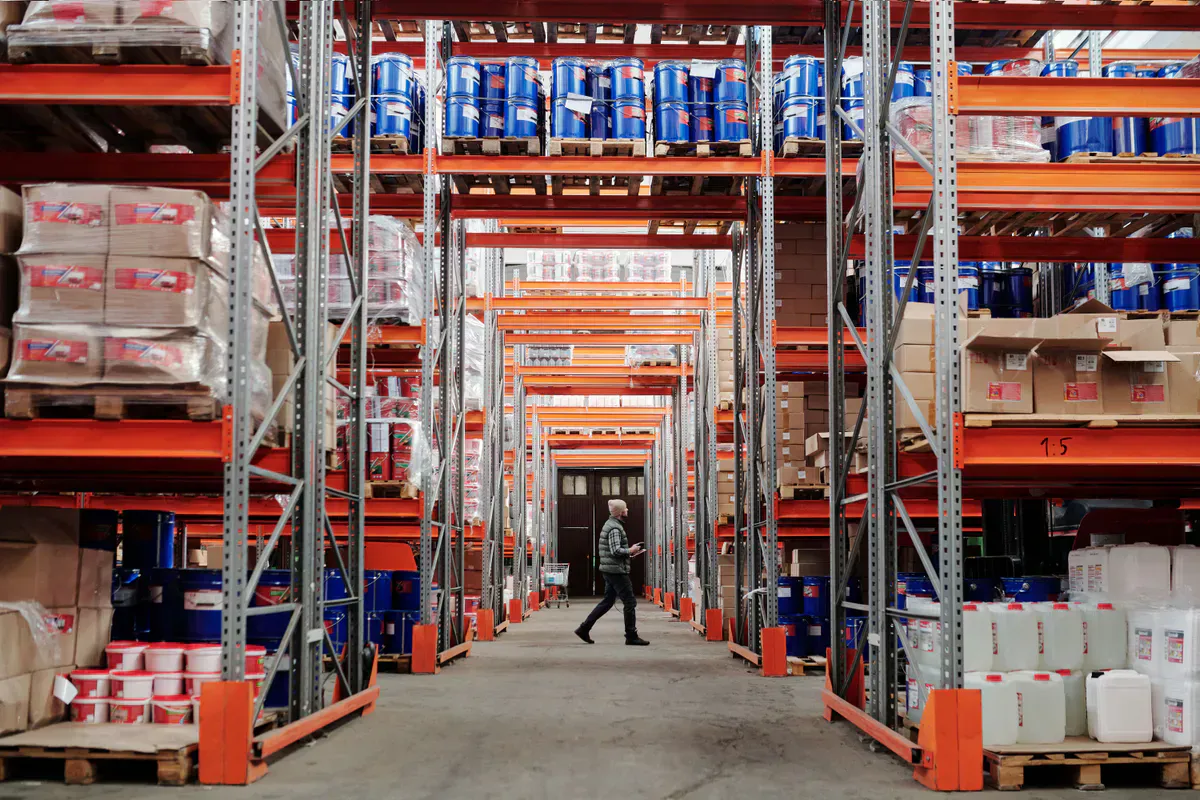
What 20,000 steps on concrete does to a boot choice
Concrete does not give anything back. Dirt compresses under your heel, asphalt has a little flex, but a warehouse slab returns every step straight up your leg. Pickers and stockers rack up miles, not hours, and the boot specs that matter for this trade follow from that one fact.
| What you need | Why it matters in a warehouse |
|---|---|
| Low weight | An ounce on the foot is lifted thousands of times a shift. Weight is the spec that decides how your legs feel at hour nine. |
| Cushioned midsole | The slab does no shock absorption, so the boot has to do all of it. |
| Composite or soft toe | A rated composite cap protects without steel weight. If your site has no toe rule, a soft toe is lighter still. |
| Slip-rated outsole | Polished concrete plus stretch-wrap scraps and dust is slicker than it looks. |
| Breathable build | Most warehouses run warm. A waterproof membrane you do not need just traps sweat. |
Composite over steel, every time, in this trade
If your warehouse requires a rated safety toe, make it composite. At the same ASTM rating a composite cap has passed the same impact and compression tests as steel, and it does it with less weight on every step. Steel earns its place in trades where things fall on feet all day. In a picking aisle, the weight saving is the whole game. The full breakdown is in our composite vs steel toe guide.
One honest note before the picks. Dedicated lightweight safety shoes exist, cut like sneakers with composite caps, and for some warehouse jobs they are a fair answer. We cover boots, and a boot still wins when you climb order pickers, kneel on pallets, or want ankle coverage around forklift traffic. The FAQ below deals with the shoe question directly.
If your arches complain on concrete no matter what you wear, the boot may not be the problem. Our flat feet guide covers support and insoles, and the slip-resistant guide goes deeper on outsoles for slick floors.
EVER BOOTS Tank (soft toe)
A light nubuck work boot at a budget price for warehouses that do not require a safety toe.
Check Price on AmazonFitVille Extra Wide Composite Toe
A composite cap, a knit upper, and the lightest claimed weight of anything we list. Built for walking shifts.
Check Price on AmazonCarhartt Rugged Flex 6" Waterproof
A mid-priced cushioned leather boot for crews that work the dock doors and the yard, not just the aisles.
Check Price on AmazonEVER BOOTS Tank (soft toe)
The Tank is the budget answer for warehouses with no safety-toe requirement. It is a plain 6-inch work boot with a nubuck leather upper, reinforced stitching, and a padded collar, and the maker pitches it as supportive without being restrictive. That is the right priority for a walking shift. No cap means no cap weight, and there is nothing on this boot you are carrying for show.
The wide rubber sole gives it a stable platform on flat concrete, and the insoles pull out if you want to drop in your own orthotics. Sizing runs true to standard big-brand boot sizing per the listing, though one wide-width buyer found the wide cut roomy enough to need a second sock and said he would go standard width next time.
| Toe | Soft toe, no safety cap |
|---|---|
| Upper | Nubuck leather, reinforced stitching |
| Sole | Wide rubber sole |
| Insole | Removable, takes custom orthotics |
| Price band | Budget |
- No safety-toe weight to carry on a walking job
- Padded collar and arch support per the listing
- Removable insole for orthotic swaps
- Budget price takes the sting out of wear-and-replace
- Laces wear out fast. Owners say buy spares up front
- Wide width runs roomy for some buyers
- Owner opinions on weight are mixed
FitVille Extra Wide Composite Toe
This is the boot built closest to what warehouse work actually asks for. The toe cap is composite, listed to the ASTM F2412-18 standard, so it satisfies a safety-toe rule without steel weight. The upper is knit, not leather, which is why the listed weight is 874 grams a pair at a US size 9. Nothing else we cover comes close to that number. Under the foot sits a Kevlar midsole for puncture resistance, which matters in a building where staples, banding clips, and broken pallet splinters live on the floor.
The spec sheet says it plainly: not water resistant. On most pages that line is a strike. Indoors it is irrelevant. Your aisles are dry, and a membrane would only cost you the breathability that knit upper is there to provide. The wide and extra-wide toe box is the other story here. FitVille cuts for splayed toes and wide forefeet, so if standard lasts pinch you, this is the rated-toe option that will not.
The honest caveats: owners consistently say to order a size up, including one who returned his usual 13 X-Wide for a 14. And durability feedback is mixed, with some reports that the upper material tears or wears early. At a budget-band price that trade-off is at least priced fairly.
| Toe | Composite cap, ASTM F2412-18 listed |
|---|---|
| Midsole | Kevlar, puncture resistant |
| Upper | Breathable knit |
| Claimed weight | 874 g per pair at US size 9 |
| Widths | Wide and X-Wide |
- Rated composite cap at the lowest claimed weight on this page
- Kevlar puncture-resistant midsole for debris-strewn floors
- Knit upper breathes in a warm building
- Real wide and extra-wide toe box options
- Runs small. Owners say go one full size up
- Durability feedback is mixed, with some early-wear reports on the upper
- Not water resistant, which only matters if your shift leaves the building
Carhartt Rugged Flex 6" Waterproof
The mid-band step up, and the pick for warehouse jobs that spill outside. Plenty of warehouse work includes the dock plate, the yard, and the trailer in January, and this is where the Rugged Flex earns its price over the two above. The oil-tanned leather upper carries a Storm Defender waterproof membrane, with a rubber bumper at the toe and heel where boots scuff out first.
For the concrete miles, the cushioning stack is the point: an EVA midsole with a polyurethane insole, built to absorb shock and cut foot fatigue, with a listed weight of 1.6 pounds. The toe is a soft toe meeting the ASTM F2892-24 standard, so it carries no rated impact cap. If your site requires one, the FitVille above is your pick instead.
Cons worth knowing before you buy: the stock laces are a running complaint, with a long-time boot wearer reporting they will not stay tied. Owner feedback on the waterproofing is mixed, with some finding them not waterproof in practice. And fit reads generous, with one reviewer calling the regular-width toe box almost Birkenstock-level wide. That roominess is a feature for some feet and a return for others.
| Toe | Soft toe, ASTM F2892-24 |
|---|---|
| Upper | Oil-tanned leather, rubber toe and heel bumper |
| Waterproofing | Storm Defender membrane |
| Cushioning | EVA midsole, polyurethane insole |
| Listed weight | 1.6 lb |
- EVA and polyurethane cushioning for full shifts on the slab
- Waterproof membrane covers dock and yard duty
- Rubber bumper protects the scuff points
- Roomy toe box if your forefoot wants space
- Stock laces will not stay tied per owners. Plan to replace them
- Waterproofing reports are mixed
- Runs large for some buyers
- No rated safety cap
Nobody walked these through a staged test course, and we will not pretend otherwise. Picks come from spec sheets, safety-standard documentation, and reading owner review patterns for what actually fails. The full method is on how we pick boots.
Common questions
Are boots good for warehouse work?
Yes, with one caveat: weight. Warehouse work is a walking job measured in miles per shift, so every ounce on your foot counts. A light composite toe boot or a safety shoe beats a heavy logger for racking and picking work.
Are cowboy boots good for warehouse work?
Honest answer: no. No safety toe, smooth soles that slip on polished concrete, and no lace lock for ladder work. Western work boots exist with rated toes and lug soles, but the dress cowboy boot in your closet should stay there.