Spec guide

The Best Slip Resistant Work Boots

First, the answer nobody prints: slip-resistant soles are built for wet and oily floors, and ice defeats nearly all of them. For floors, compound and tread decide everything. Here is how to read the claims, and the picks whose claims we could verify.

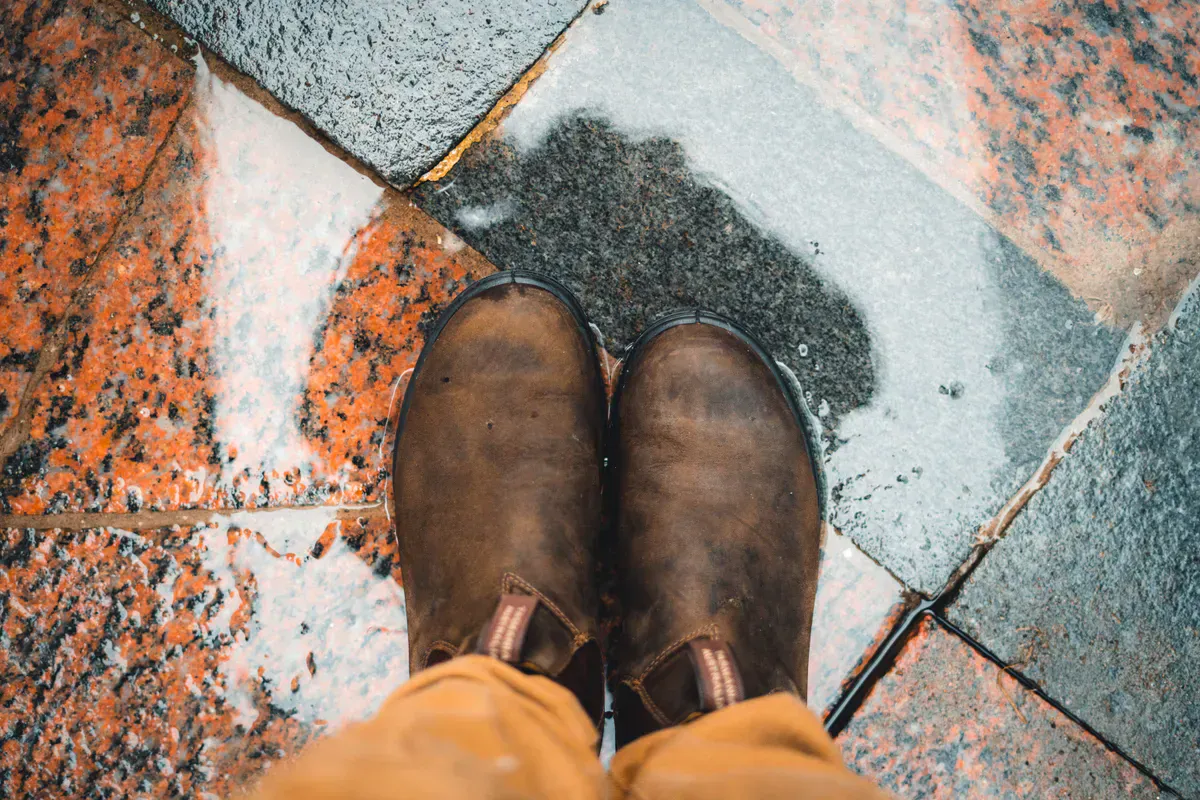
Looking down at brown slip-on boots standing on wet, slick tile pavement

Disclosure: The Boot Index is reader supported. As an Amazon Associate we earn from qualifying purchases made through links on this page, at no extra cost to you. How this works.

What makes a sole grip

Two factors do the work. The rubber compound comes first: softer compounds conform to the floor's micro-texture and grip better, at the cost of wearing faster. Tread design comes second: channels that push water and oil out from under the sole, with enough edge surface to bite. A hard flat slick of rubber fails wet no matter what the marketing tag says.

Claims come in grades. "Slip resistant" on its own is a marketing phrase. A named compound built for oil and slip resistance is better. A stated standard is best; ASTM F3445 is the current US slip-resistance test standard, and in our verified pool only the Thorogood American Heritage moc toes state it. The picks run in that order of evidence.

And ice: mostly no. Standard rubber hardens and skates on ice regardless of tread. Real ice work means dedicated cold-grip compounds or strap-on cleats over the boot. A "slip resistant" tag will not save you on a frozen lot, and we would rather lose a click than let that one slide.

Top picks at a glance

Budget pick

FitVille Wide Composite Toe

Slip-resistant build with a composite toe and Kevlar puncture midsole at a budget price. Indoor floors are its lane.

Check Price on Amazon
Our pick

Timberland PRO Pit Boss

Rubber compound built for slip, oil, and abrasion resistance, with heat resistance on top. The shop-floor standard.

Check Price on Amazon
Premium pick

Thorogood Heritage 6"

A stated slip-resistance standard, not just a claim: MAXWear wedge to ASTM F3445-21, wet and oily surfaces included.

Check Price on Amazon
Budget pick

FitVille Extra Wide Composite Toe

FitVille states slip resistance for floor-heavy workplaces, warehouse, factory, restaurant, garage among them, and backs the safety story with a composite toe cap to ASTM F2412-18 and a Kevlar-reinforced puncture midsole. At 874 grams a pair in a size 9 it is the lightest thing on this page, which matters on a walking shift. The wide and extra-wide builds are the brand's whole identity, covered fully in the wide feet guide.

Its limits are stated plainly on its own listing: not water resistant, so wet means indoor wet, not weather. Owners advise going a size up, and some report the knit upper tearing early.

Slip claimSlip-resistant build, maker stated
ToeComposite cap, ASTM F2412-18
MidsoleKevlar reinforced, puncture resistant
Weight874g per pair, size 9
Pros
  • Lightest pick on the page
  • Composite toe and puncture midsole at budget money
  • Real wide and extra-wide builds
Cons
  • Not water resistant, by its own spec table
  • Runs small; owners say size up
  • Knit upper durability complaints exist
Check Price on Amazon
Our pick

Timberland PRO Pit Boss 6"

The Pit Boss earns the middle slot on its outsole: Timberland PRO's rubber compound is built for slip, oil, and abrasion resistance, with heat resistance in the same package. That is the named-compound grade of evidence, and it comes attached to a steel toe meeting ASTM F2412-18a and F2413-18 plus EH protection to F2892-18. For shop floors that mix oil, water, and dropped steel, it is the full answer.

The known catch is sizing, which owners describe as inconsistent in both directions. Plan a possible exchange. Details in the mechanics guide, where this boot also features.

OutsoleRubber, slip, oil, abrasion and heat resistant
ToeSteel, ASTM F2412-18a / F2413-18
ElectricalEH rated, ASTM F2892-18
Comfort24/7 comfort suspension system
Pros
  • Named compound for slip, oil, abrasion
  • Full safety stack on top of the grip
  • Top-ten seller in its category with a long track record
Cons
  • Sizing inconsistency is the recurring owner theme
  • Steel toe carries steel-toe weight; see the toe guide
Check Price on Amazon
Premium pick

Thorogood American Heritage 6" Moc Toe

This is the standard-stated pick. Thorogood's MAXWear wedge outsole meets ASTM F3445-21, the actual slip-resistance test standard, with wet and oily surfaces and loose gravel called out in the maker's claim. The only other boot in our verified pool that states the standard is its 8-inch sibling, which carries the same outsole. Around that sole: USA construction, oil-tanned full-grain leather, Goodyear storm welt that makes it resoleable, and EH resistance to F2892-18. A wedge sole also puts maximum rubber on the floor, which is the geometry you want on smooth concrete.

Owner cautions are the same ones from our other Thorogood coverage: a narrow fit until break-in and scattered reports of sole separation at the toe. It is a soft toe, so it pairs with jobs where the floor is the hazard, not falling steel.

Slip standardASTM F3445-21, MAXWear wedge
ConstructionGoodyear storm welt, USA made, resoleable
ElectricalEH rated, ASTM F2892-18
ToeSoft toe
Pros
  • The only stated ASTM F3445-21 rating in our pool
  • Wedge geometry maximizes floor contact
  • Resoleable when the wedge wears smooth
Cons
  • Runs narrow until broken in
  • Some owners report sole separation at the toe
  • Soft toe only at this model
Check Price on Amazon

One we left off

The EVERBOOTS Tank S markets anti-slip grip, but its owner reports cut the other way, with several noting the soles can slip on concrete. When the marketing and the owners disagree, we side with the owners. It still earns a slot in the ironworker guide on its steel shank, where floor grip is not the headline job.

Which trades need this page

Mechanics on oily slab, drivers on diesel-spotted pavement, warehouse crews on polished concrete, and roofers, whose grip problem is its own page.

How these picks get made, and what we will not claim: how we pick boots.

Common questions

Do slip resistant boots work on ice?

Mostly no, and you should hear that before buying. Slip-resistant outsoles are designed and tested for wet and oily floors. Ice defeats nearly all standard rubber compounds. For real ice you need dedicated cold-grip compounds or strap-on traction cleats.

What makes a boot slip resistant?

Two things: the rubber compound, softer compounds grip better, and the tread design, with channels that push liquid out from underfoot. A flat slick of hard rubber fails on a wet floor no matter what the tag claims.